
For more than three thousand years, across desert tabernacles, stone temples, ancient synagogues, and modern church sanctuaries, one sacred prayer has echoed with unmatched majesty: the Priestly Blessing. Recorded in Numbers 6:24–26, this divinely authored benediction—frequently called the Aaronic Blessing or Birkat Kohanim—was commanded by God Himself to Moses as the perpetual formula through which Aaron and his descendants would place the holy Name of the Almighty upon His people.
Far more than a sentimental farewell, the Priestly Blessing is an authoritative spiritual impartation of covenant protection, unmerited grace, and supernatural peace. In this definitive guide, explore the word-by-word Hebrew meaning of this timeless benediction, its historic practice in Temple worship, its adoption in Christian church liturgies, the Shabbat tradition of blessing children, and the miraculous archaeological discovery of the Ketef Hinnom silver scrolls—the oldest surviving biblical text in human history.
What Is the Priestly Blessing? (Numbers 6:22–27)
The Priestly Blessing (also known as the Aaronic Blessing or Birkat Kohanim) is the ancient, divinely commanded benediction given by God to Moses, instructing Aaron and his sons to speak covenant favor, divine protection, and holy peace over the people of Israel. Recorded in Numbers 6:24–26, this three-line invocation stands as the oldest, most recited prayer of blessing in human history. It is neither human well-wishing nor a mere polite sentiment; rather, it is an authoritative spiritual impartation in which God Himself promises: “And they shall put My name upon the children of Israel; and I will bless them” (Numbers 6:27). Whether spoken during ancient Temple services or proclaimed as a morning benediction—much like believers declare a Tuesday blessing to anchor their mid-week steps—the Priestly Blessing carries timeless spiritual authority. Below are 10 foundational truths revealing the heart of this sacred benediction:
- Direct Divine Origin: The blessing originated not with Moses or Aaron, but directly from the mouth of Yahweh as a perpetual statute.
- Priestly Consecration: God designated the sons of Aaron as exclusive human conduits through whom His heavenly favor would be proclaimed.
- Placing God’s Name: Pronouncing the benediction functions as placing God’s holy name (the Tetragrammaton) like an indelible seal of ownership upon His people.
- Tripartite Structure: The blessing unfolds in three distinct, poetic lines of ascending length (3 words, 5 words, and 7 words in Hebrew).
- Holistic Covenant Favor: It addresses every sphere of human existence: physical provision, emotional protection, relational grace, and spiritual tranquility.
- God as the Active Agent: Each clause explicitly identifies the Lord as the initiator who protects, illuminates, and establishes peace.
- Individual Personal Address: In the original Hebrew, every pronoun is singular (‘thee’ and ‘thy’), assuring each individual that God sees and knows them personally.
- The Shining Face of God: The metaphor of God’s radiant face represents divine intimacy, acceptance, and the total absence of condemnation.
- Unmerited Grace (Chanan): The middle petition asks God to be gracious, underscoring that blessings flow from sovereign mercy rather than human merit.
- Culmination in Shalom: The benediction reaches its ultimate climax in ‘shalom’—the comprehensive state of harmony, completeness, and wholeness.
The Hebrew and English Text of the Priestly Blessing (Word-by-Word Meaning)
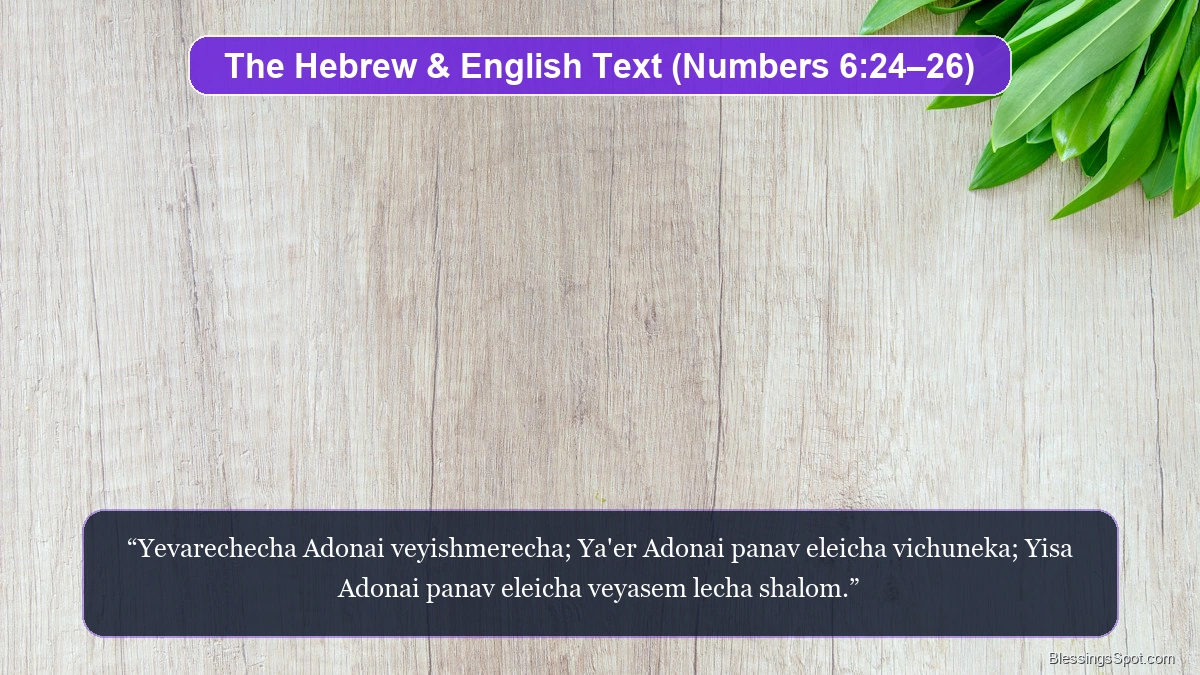
Examining the original biblical Hebrew of Numbers 6:24–26 reveals a masterpiece of divine literary symmetry, where the number of words, syllables, and letters systematically increases with each subsequent line. In Hebrew, Line 1 contains 3 words and 15 letters; Line 2 contains 5 words and 20 letters; and Line 3 contains 7 words and 25 letters. This mathematical expansion symbolically portrays God’s favor continually multiplying over the believer’s life. Below is the word-by-word transliteration and deep linguistic meaning of the 10 core Hebrew terms in the Priestly Blessing:
- Yevarechecha (יְבָרֶכְךָ): “The Lord bless you” — Rooted in barak, meaning to bend the knee and bestow abundant, tangible goodness.
- Adonai (יהוה): “The Lord” — God’s personal, covenantal name revealing His eternal, self-existent faithfulness to His promises.
- Veyishmerecha (וְיִשְׁמְרֶךָ): “And keep you” — From shamar, meaning to erect a protective hedge of thorns, guarding your life from physical and spiritual harm.
- Ya’er (יָאֵר): “Make shine” — From or (light), asking God to cause the brilliant dawn of His glory to illuminate your darkest circumstances.
- Panav (פָּנָיו): “His face / countenance” — Signifies personal presence, direct eye contact, intimacy, and warm approval rather than divine hiddenness.
- Eleicha (אֵלֶיךָ): “Toward you” — Demonstrates God’s personal, directed attention toward your individual needs, fears, and hopes.
- Vichuneka (וִיחֻנֶּךָּ): “And be gracious unto you” — From chanan, imparting tender compassion, unmerited kindness, and supernatural rescue in times of weakness.
- Yisa (יִשָּׂא): “Lift up” — Picture a loving father lifting his eyes to gaze upon his beloved child, or lifting the child into a warm embrace.
- Veyasem Lecha (וְיָשֵׂם לְךָ): “And give / establish for you” — A sovereign appointment establishing a permanent, unshakable reality.
- Shalom (שָׁלוֹם): “Peace” — Far beyond quietness, shalom denotes sound health, safety, emotional wholeness, prosperity, and total reconciliation.
Birkat Kohanim: The Priestly Blessing in Temple Worship & Synagogue Liturgy

Birkat Kohanim (the Blessing of the Priests, colloquially known in Yiddish as ‘duchening’) has been performed continuously from the days of the Tabernacle in the wilderness through the First and Second Temples to contemporary synagogue services. In Jerusalem, Kohanim chant the blessing daily at the Western Wall (Kotel), where tens of thousands gather during the festivals of Passover and Sukkot. The Kohanim do not bless by their own merit or power; they are simply transparent conduits of the divine presence (Shechinah). Below are 10 sacred customs and rituals associated with Birkat Kohanim:
- Ritual Hand Washing: Before ascending the platform, Levites wash the hands of the Kohanim to sanctify them for the holy duty.
- Removal of Leather Shoes: Just as Moses removed his sandals on holy ground, priests remove their shoes before delivering the benediction.
- Ascending the Platform (Duchan): Priests mount the platform facing the holy ark before turning to face the congregation.
- Covering with the Tallit: The Kohanim cover their heads, faces, and hands entirely with prayer shawls so the congregation does not gaze upon them.
- The Invisible Presence: Tradition teaches that the Shechinah rests upon the hands of the priests during the blessing; covering the eyes emphasizes that God alone is the source of blessing.
- The Sacred Hand Sign: Hands are held aloft at shoulder height with fingers split between middle and ring fingers, forming the Hebrew letter Shin (ש) representing El Shaddai.
- Echoing Chanted Melody: The cantor recites each word aloud first, and the Kohanim chant it back in an ancient, solemn, lingering melody.
- Congregational Response: After each of the three verses, the congregation responds with a resounding, reverent “Amen!”
- Pronouncing the Ineffable Name: In the ancient Temple, the High Priest uttered the sacred four-letter Name of God; in synagogues today, the substitute Adonai is spoken.
- Covenant of Peace: The rite concludes with gratitude, sealing the congregation in spiritual safety and divine friendship.
The Priestly Blessing in Christian Worship and Church Benedictions
From the earliest centuries of Christianity, the Church embraced Numbers 6:24–26 as one of the most sublime closing benedictions for Eucharistic and Sunday worship services across Catholic, Lutheran, Anglican, Presbyterian, Methodist, and Evangelical traditions. Christian theology views the threefold structure of the blessing as an Old Testament foreshadowing of the Holy Trinity. In the New Testament, Jesus Christ is revealed in the Epistle to the Hebrews as the eternal Great High Priest who continually lives to intercede for and bless His people. Consider these 10 theological insights and Christian liturgical uses of the Priestly Blessing:
- Trinitarian Harmony: The three verses correspond beautifully: the Father keeps and protects; the Son brings light and saving grace; the Holy Spirit imparts enduring peace.
- Christ as the High Priest: Jesus lifted up His hands and blessed His disciples as He ascended into heaven (Luke 24:50), embodying the true Aaronic High Priest.
- The Priesthood of All Believers: Under the New Covenant (1 Peter 2:9), every Christian has access to God’s presence and is empowered to pronounce blessings over others.
- Martin Luther’s Reformation Liturgy: Martin Luther included the Aaronic Blessing as the solemn conclusion of the German Mass (Deutsche Messe) in 1526.
- Anglican Book of Common Prayer: The blessing is featured prominently in Anglican pastoral offices, visits to the sick, and concluding Eucharistic prayers.
- Catholic Sacramental Benediction: In Catholic rites, the blessing is frequently recited over confirmands, newly ordained priests, and newlyweds.
- Modern Worship Songs: The global contemporary worship anthem “The Blessing” (Kari Jobe, Cody Carnes, Elevation Worship) popularized Numbers 6:24–26 across millions of homes worldwide.
- Dismissal in Peace: Pronounced at the conclusion of worship, the blessing sends believers out into secular vocations with divine authorization and courage.
- Reconciliation Through the Cross: Christians understand God’s face shining upon us because the barrier of sin was removed once and for all by Christ’s sacrifice.
- Eternal Assurance: The benediction reassures believers that despite personal failures during the week, God’s final word over their lives is unmerited grace and peace.
Blessing Your Children: The Shabbat and Family Priestly Benediction

One of the most touching family traditions across Jewish and Christian heritage is the weekly custom of parents laying their hands upon their children’s heads on Friday evening to pronounce the Priestly Blessing. This ritual imparts spiritual identity, emotional security, and generational faith. Psychological and sociological studies indicate that children who receive consistent, physical, vocal blessings from their parents experience higher self-esteem, lower anxiety, and stronger moral resilience. Below are 10 transformative aspects of speaking the Priestly Blessing over your children and family:
- Physical Touch of Blessing: Placing gentle hands on a child’s head communicates unconditional acceptance, warmth, and physical protection.
- Blessing for Sons: Preceded by the invocation: “May God make you like Ephraim and Manasseh”—honoring two brothers who remained faithful in pagan Egypt without sibling jealousy.
- Blessing for Daughters: Preceded by: “May God make you like Sarah, Rebecca, Rachel, and Leah”—the holy matriarchs who built the house of Israel with wisdom and strength.
- Inoculation Against Cultural Pressure: Hearing holy declarations weekly inoculates children’s hearts against peer pressure, consumerism, and toxic cultural messaging.
- Healing Parental Relationships: Even during difficult teenage years, the weekly blessing provides an unbroken bridge of love, forgiveness, and mutual reconciliation.
- A Spiritual Hedge of Protection: Praying “The Lord keep you” establishes spiritual guardianship over children when they are away at school or among peers.
- Cultivating God-Consciousness: Children grow up knowing that their true identity and worth are anchored in God’s favor rather than academic or athletic performance.
- Blessing the Spouse: Spouses frequently recite Proverbs 31 and the Priestly Blessing over each other, deepening marital intimacy and spiritual partnership.
- Generational Heritage: Grandparents laying hands on multiple generations creates indelible memories of faith that outlive earthly possessions.
- Bedtime and Morning Ritual: Beyond Friday nights, speaking this blessing as children head out the door or drift off to sleep creates a peaceful household atmosphere.
Archaeological Discovery: The Ketef Hinnom Silver Amulet Scrolls

In 1979, Israeli archaeologist Gabriel Barkay made one of the most astonishing archaeological discoveries of all time in a burial cave at Ketef Hinnom, overlooking the Old City of Jerusalem. Buried beneath a rock bench were two miniature, tightly rolled silver scrolls (dating to approximately 650–600 BCE, late First Temple period). When carefully unrolled by conservators at the Israel Museum, researchers discovered microscopic Paleo-Hebrew script containing the exact words of the Priestly Blessing from Numbers 6:24–26! Below are 10 vital facts about the Ketef Hinnom discovery:
- Oldest Surviving Biblical Texts: The Ketef Hinnom silver scrolls predate the famous Dead Sea Scrolls by more than 350 to 400 years.
- First Temple Period Verification: They confirm that the text of the Priestly Blessing was in active liturgical and devotional use prior to the Babylonian exile in 586 BCE.
- Rebuttal of Minimalist Theories: The discovery conclusively refuted 19th-century academic theories that claimed the Priestly Code was invented centuries later in the Hellenistic era.
- Personal Apotropaic Amulets: The tiny silver plaques were rolled into cylinders with perforations, indicating they were worn around the neck as personal protective amulets.
- Microscopic Paleo-Hebrew Script: The inscriptions were etched onto pure silver foil with an extremely fine stylus in the ancient Hebrew alphabet.
- The Divine Name Inscribed: Ketef Hinnom Scroll 1 preserves the sacred Tetragrammaton (YHWH) alongside covenant promises of steadfast love.
- Exact Wording Preserved: Scroll 2 contains the precise words: “May Yahweh bless you and keep you; may Yahweh make His face shine upon you and give you peace.”
- Accidental Discovery: The repository was discovered by a 13-year-old volunteer assistant, Nathan Hanan, who crawled into an unnoticed crevice beneath the tomb floor.
- Preserved Through Devastation: While grave robbers plundered the primary tomb chambers in antiquity, the hidden repository remained completely untouched for 2,600 years.
- Enduring Testimony: Today, these silver scrolls are permanently displayed in the Israel Museum in Jerusalem, testifying to the miraculous preservation of Scripture.
The Spiritual Depth of ‘Shalom’: The Culmination of the Blessing

The Priestly Blessing ascends toward a single, climactic Hebrew word: Shalom (שָׁלוֹם). In Western thought, peace is often defined negatively as the mere absence of warfare, noise, or conflict. In biblical thought, however, shalom is an active, positive, multidimensional reality rooted in the verb shalam, meaning to make whole, restore, pay back, or complete. God concludes His greatest blessing with shalom because when a person possesses divine shalom, they lack nothing essential for their spiritual, emotional, and physical well-being. Explore these 10 rich dimensions of biblical Shalom:
- Wholeness and Completeness: Shalom denotes that every fractured part of your life is integrated, healed, and made completely whole by God.
- Reconciliation with God: Divine peace is primarily vertical; having peace with God through forgiveness removes all spiritual estrangement.
- Emotional Tranquility: Shalom calms turbulent anxieties, quelling panic and replacing racing thoughts with tranquil confidence.
- Physical Health and Well-being: In ancient Israel, asking about someone’s shalom was an inquiry into their bodily health and vitality.
- Relational Harmony: Shalom heals fractured marriages, resolves sibling rivalries, and creates empathetic understanding across communities.
- Economic and Vocational Fruitfulness: Biblical shalom encompasses peaceful productivity where families enjoy the fruit of their honest labors.
- Safety from Calamity: The blessing of shalom creates an invisible spiritual shield turning away sudden terror and destructive violence.
- Covenant of Peace: In Numbers 25:12, God establishes His Brit Shalom (Covenant of Peace), an unbreakable promise of eternal goodwill.
- Prince of Peace (Sar Shalom): Prophesied in Isaiah 9:6, Jesus Christ is the ultimate embodiment of divine shalom bringing heaven to earth.
- A Perpetual Benediction: Proclaiming shalom over your life ensures that no matter how turbulent external circumstances become, your inner sanctuary remains calm.
How to Pray and Proclaim the Priestly Blessing Over Your Life Daily

Personalizing and vocalizing the Priestly Blessing in your daily prayer time allows you to align your mind, home, and daily routine with God’s covenant promises. When you declare Numbers 6:24–26 over yourself and your loved ones, you are actively inviting the Almighty to place His name upon your household. Below are 10 practical prayers and daily declarations based on the Priestly Blessing to speak each morning:
- “The Lord bless me and keep me today. Father, build a hedge of holy protection around my mind, body, and emotions against every snare of fear.”
- “The Lord make His radiant face shine upon me. Lord, let me walk in the conscious joy of Your acceptance, intimacy, and delight today.”
- “The Lord be gracious unto me. In moments of weakness or mistake, shower me with Your unmerited mercy and supernatural help.”
- “The Lord lift up His countenance upon me. Thank You, Father, that Your eyes are continually upon me for good and never for harm.”
- “The Lord give me His shalom. I receive divine peace that guards my heart against workplace stress, relational conflict, and anxiety.”
- “Lord, put Your name upon my family today. Let our home be known as a sanctuary of Your presence, hospitality, and righteousness.”
- “I declare that I am kept by the power of God. No weapon formed against my life, my children, or my calling shall prosper.”
- “Father, let the light of Your countenance illuminate my decisions today. Give me clarity in perplexity and wisdom in every meeting.”
- “I speak the Priestly Blessing over my marriage. May our love be preserved, our friendship deepened, and our home filled with peace.”
- “May the blessing of the Lord make me spiritually rich, and may He add no sorrow with it. I step boldly into today under heaven’s favor. Amen.”
Frequently Asked Questions About the Priestly Blessing
What is the exact text of the Priestly Blessing in the Bible?
The Priestly Blessing in Numbers 6:24–26 states: “The Lord bless thee, and keep thee: The Lord make his face shine upon thee, and be gracious unto thee: The Lord lift up his countenance upon thee, and give thee peace.”
What does Birkat Kohanim mean in Judaism?
Birkat Kohanim translates from Hebrew as “the Blessing of the Priests.” It refers to the ancient ritual where male descendants of Aaron raise their hands beneath their prayer shawls to pronounce God’s threefold covenant blessing over the synagogue or Temple congregation.
Why do priests split their fingers during the blessing?
Kohanim separate their fingers to form the Hebrew letter Shin (ש), representing El Shaddai (God Almighty). This sacred hand posture symbolizes the divine presence peering through windows and lattices (Song of Solomon 2:9) to channel blessings upon the gathered worshippers.
What are the Ketef Hinnom silver scrolls?
The Ketef Hinnom silver scrolls are two miniature 7th-century BCE amulets unearthed in Jerusalem in 1979. Inscribed with Numbers 6:24–26 in Paleo-Hebrew, they represent the oldest surviving fragments of biblical text in the world, predating the Dead Sea Scrolls.
Can anyone pray the Priestly Blessing today?
Yes, any believer can pray the Priestly Blessing. Under the biblical priesthood of all believers (1 Peter 2:9), parents frequently bless their children, pastors conclude church services, and individuals proclaim Numbers 6:24–26 as a daily prayer of divine protection and peace.
Conclusion
The Priestly Blessing remains humanity’s most sublime window into the benevolent heart of Almighty God. Across thousands of years, this divine benediction has sustained generations through exile, persecution, personal sorrow, and daily labor. It assures us that God is not an indifferent observer of human history; rather, He actively leans forward, causing His face to shine warmly upon you and ordering His peace over your life.
Make this ancient benediction an active part of your spiritual vocabulary. Speak it over your children at bedtime, declare it over your spouse, write it inside cards for friends, and whisper it over your own heart when anxiety looms. May the Lord bless you and keep you, may His radiant countenance shine warmly upon your path, and may His heavenly shalom guard your soul today, tomorrow, and forevermore.

Riya Whitman is an inspirational content writer at BlessingsSpot.com, where she shares uplifting blessings, heartfelt quotes, and positive messages for everyday life. Her writing focuses on spreading encouragement, gratitude, and hope through thoughtful words that readers can share with friends and family. Riya enjoys creating meaningful content that helps people begin their mornings with positivity and reflect on life’s simple blessings.
2 thoughts on “Priestly Blessing: Numbers 6:24–26 Meaning, Hebrew Text & Prayers”